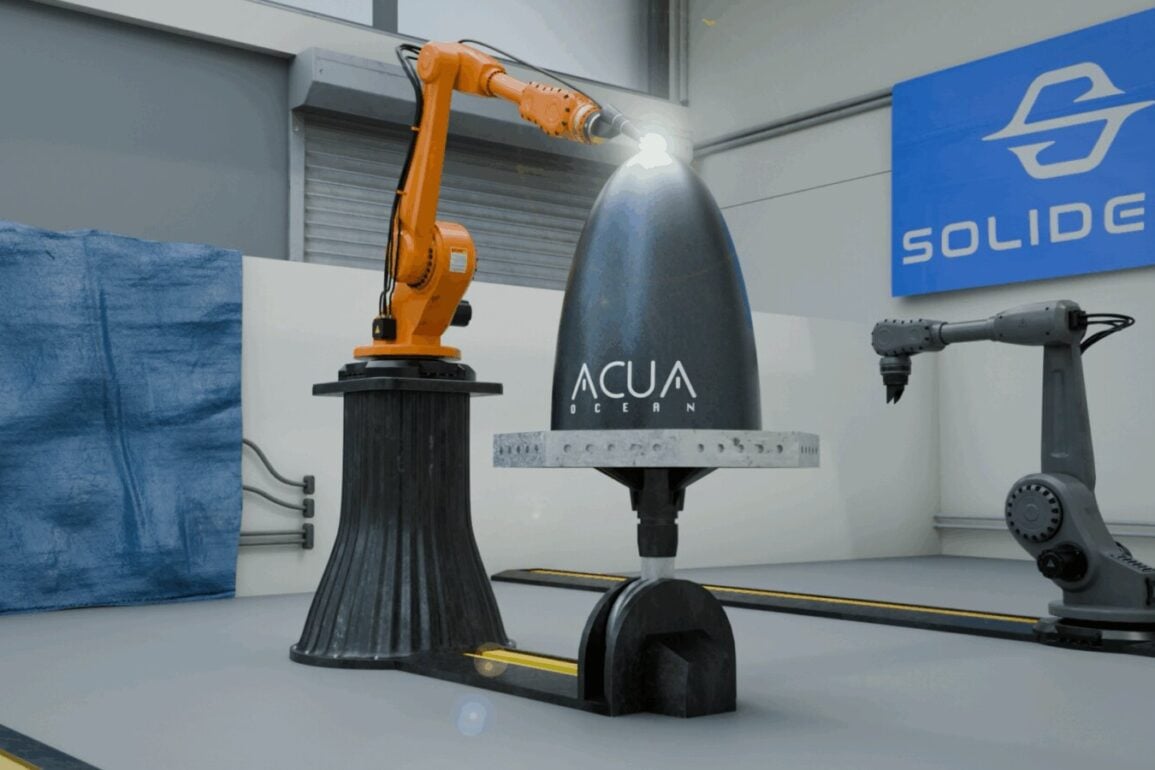
Unmanned vessels are changing naval strategy fast. The designs evolve quickly, and the systems can go out of date before a traditional production line has finished tooling up to build them. That mismatch is behind an agreement between Solideon and ACUA Ocean.
On August 20, 2025, the two companies signed a strategic memorandum of understanding to accelerate dual-use manufacturing aligned with AUKUS, the security partnership between Australia, the United Kingdom and the United States. Solideon was then based in Berkeley, California. ACUA Ocean, founded in 2021 by Neil and Mike Tinmouth, is based in Plymouth in the U.K. and designs unmanned surface vessels for offshore and subsea work.
What the agreement covers
The plan includes a technical demonstration of Solideon’s autonomous manufacturing cells adapted for maritime and austere environments, joint commercialization in the U.S. and the U.K., and co-development of workflows that run from design to deployment, including printable blueprints for vessels and components. The two companies described the idea as robots building robots.
The work aligns with AUKUS Pillar II, the part of the partnership focused on advanced technologies shared between the allies.
Why speed is the point
ACUA’s co-founder and chief operating officer, Mike Tinmouth, framed the problem as one of production cycles that cannot keep up with how quickly systems change. Solideon’s approach is meant to close that gap: standard industrial robot arms coordinated by its own software, forming reconfigurable cells that can produce new designs without new tooling.
Oluseun Taiwo, Solideon’s founder and CEO, described the company’s ambition in broad terms.
“We’re building a system to build any tech wherever it’s needed.”
A growing maritime focus
The ACUA agreement is one of several maritime moves by Solideon. The company took part in the U.S. Navy’s Trident Warrior 2025 exercise, and in September 2025 it opened Solideon Defense in Norfolk, Virginia, with shipbuilder Fairlead to make submarine hull sections and large defense hardware.
It also holds a $1.25 million AFWERX contract with the U.S. Air Force for a single-pallet cell that can make parts at expeditionary sites.
For allies trying to field unmanned systems at the pace of change, the appeal is direct. Instead of waiting for a factory to tool up, build the factory into the process, and let the robots make the next robot.